Safe lifting limits
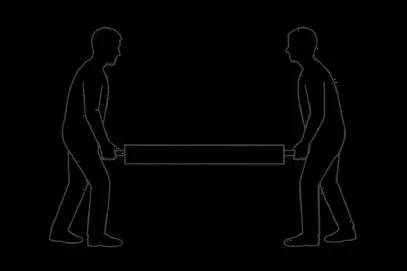
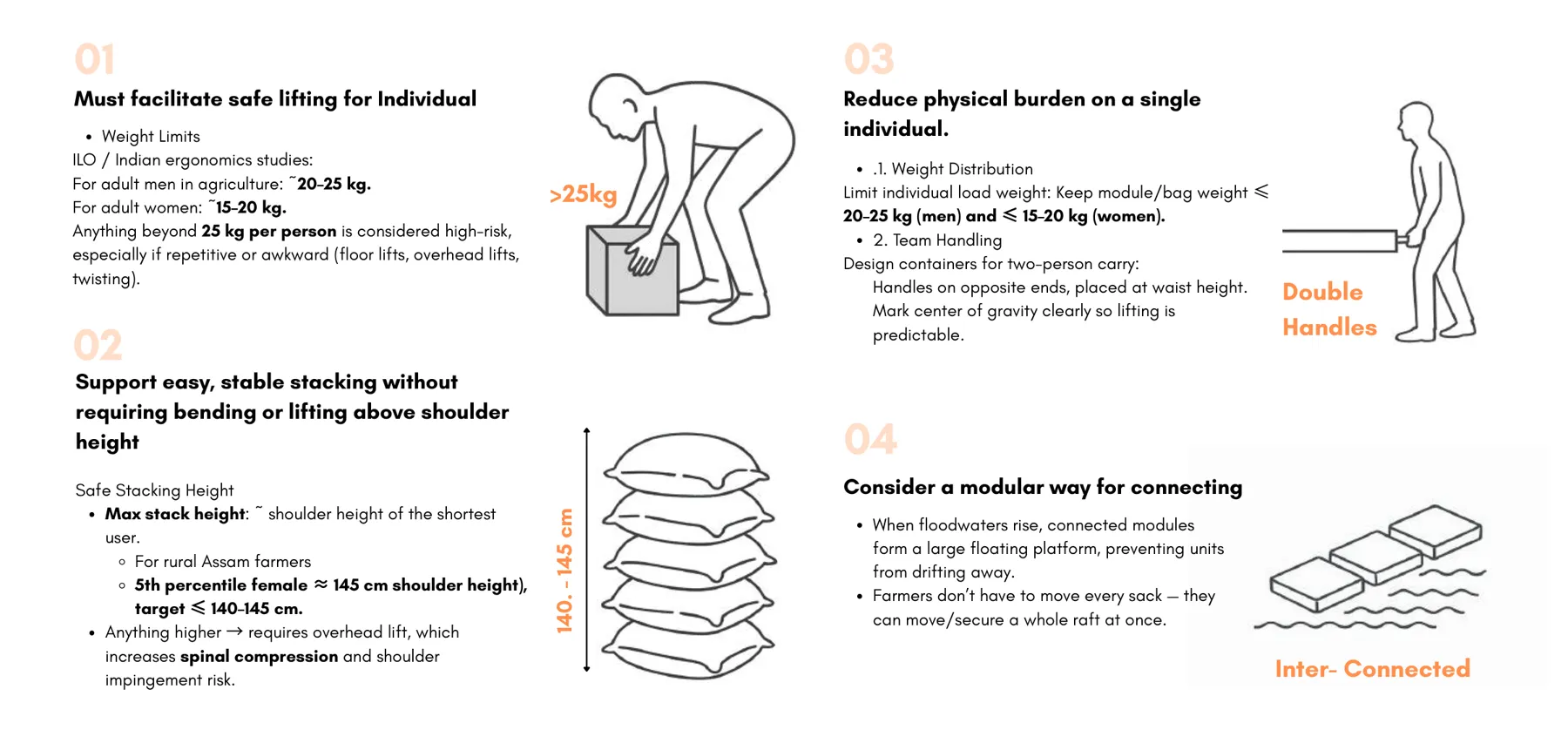
Ergonomic guidance for agricultural work puts safe loads around 20–25 kg for men and 15–20 kg for women, so one person should never handle more than a single sack.
Flood-proof crop storage for farmers on Assam’s river islands, built from bamboo and coconut husk.
Every monsoon, floods on the Brahmaputra’s char (river island) areas destroy stored grain, wiping out a year’s food and income for families who live almost entirely off rice, jute and seasonal vegetables.
Traditional raised platforms, earthen pots and hanging baskets work for small floods but fail in long ones, while silos and hermetic bags are too costly or not built to float.
Ergonomic guidance for agricultural work puts safe loads around 20–25 kg for men and 15–20 kg for women, so one person should never handle more than a single sack.
Stack height was capped at about 140–145 cm, the shoulder height of a 5th-percentile woman, to avoid overhead lifting.
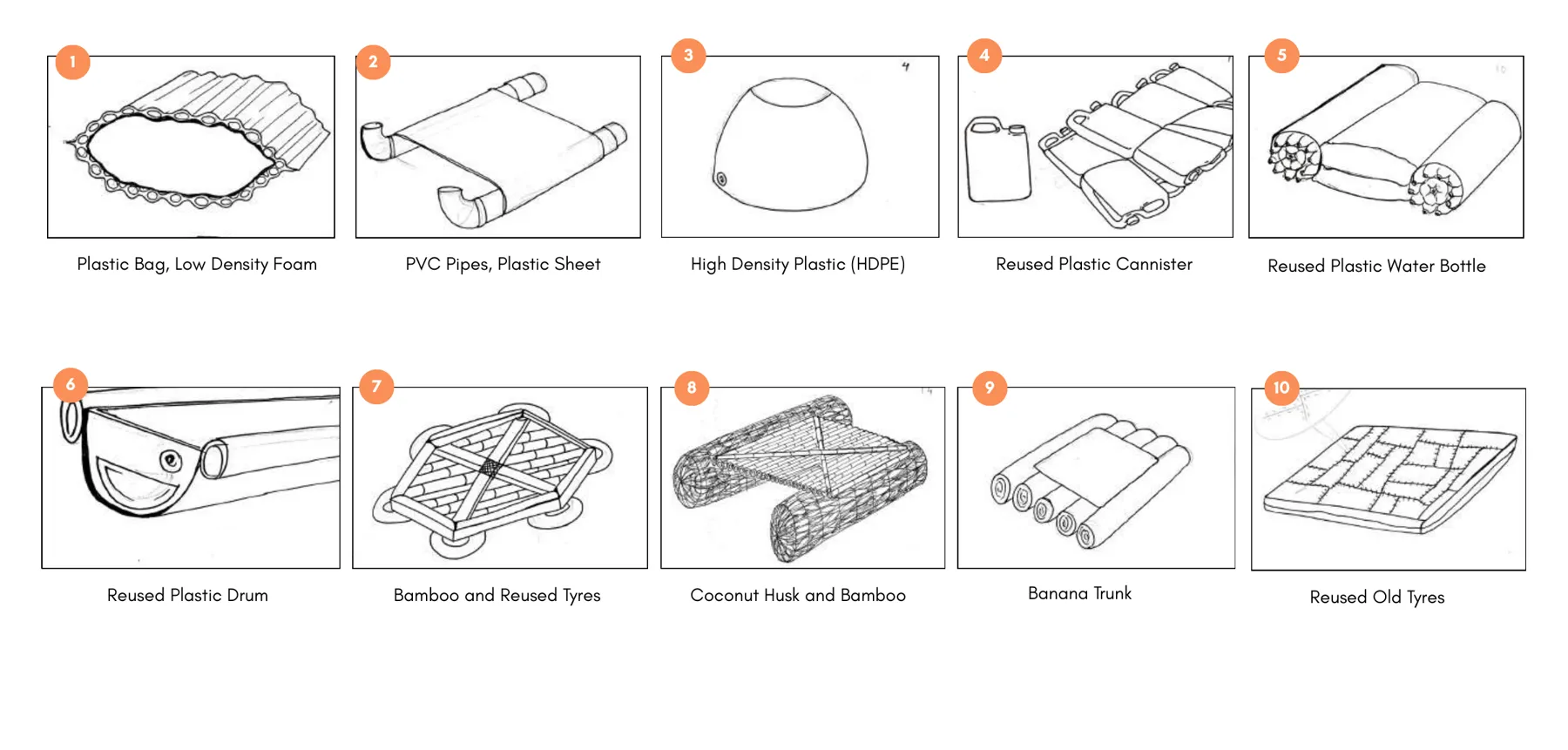
A market study of ten storage types showed the gap: nothing cheap, buoyant, repairable and locally made at the same time.
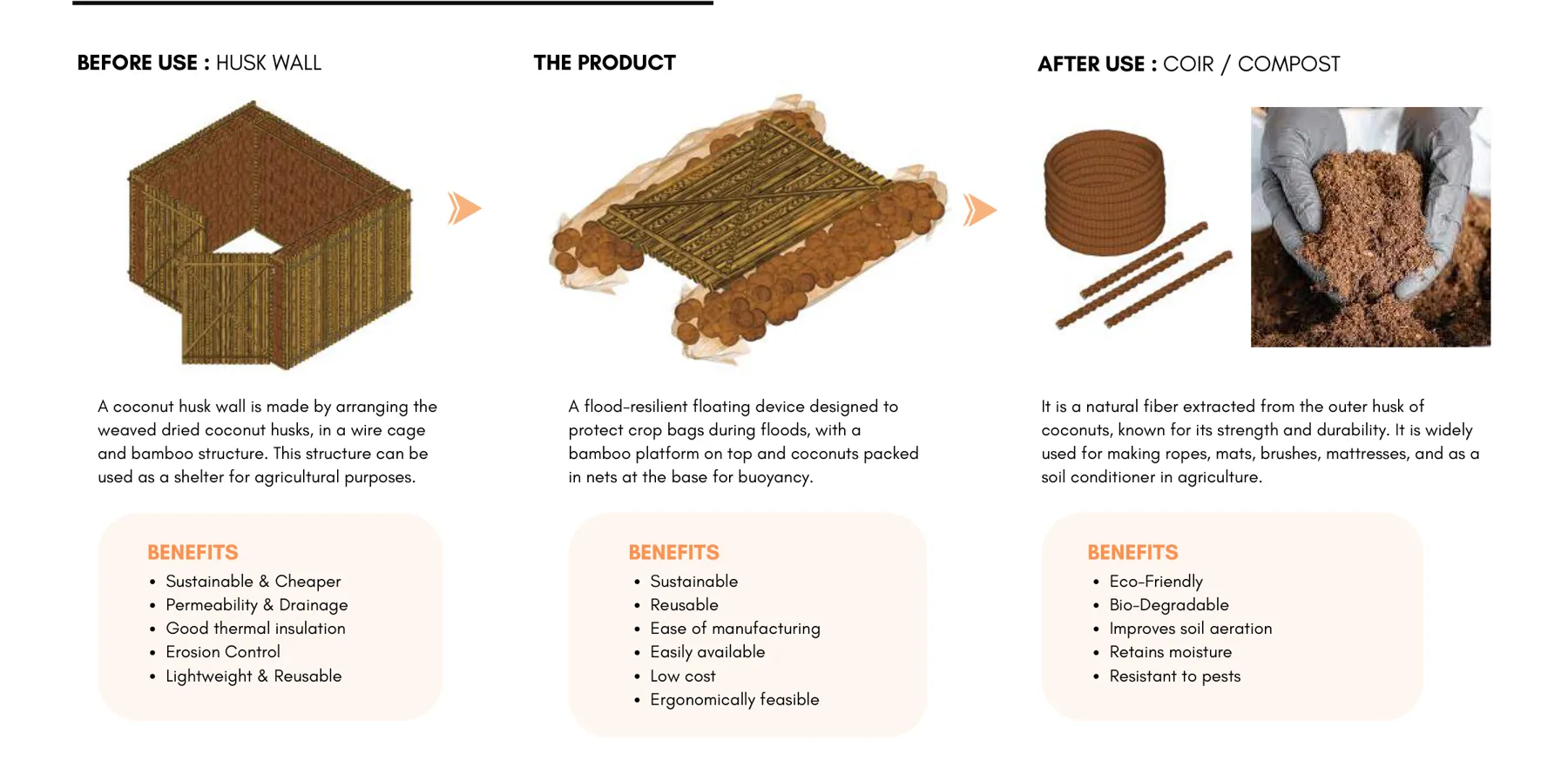
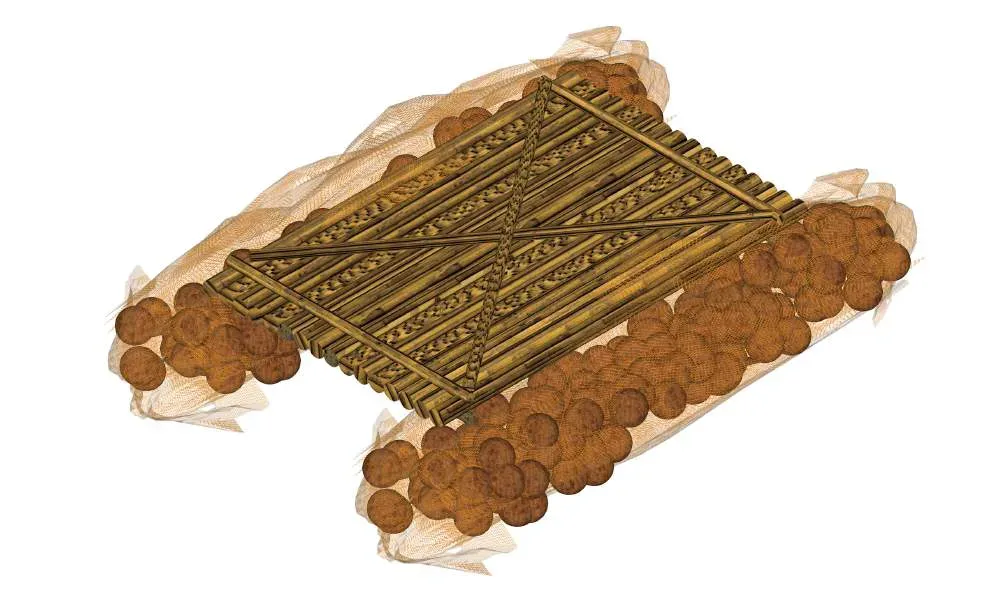
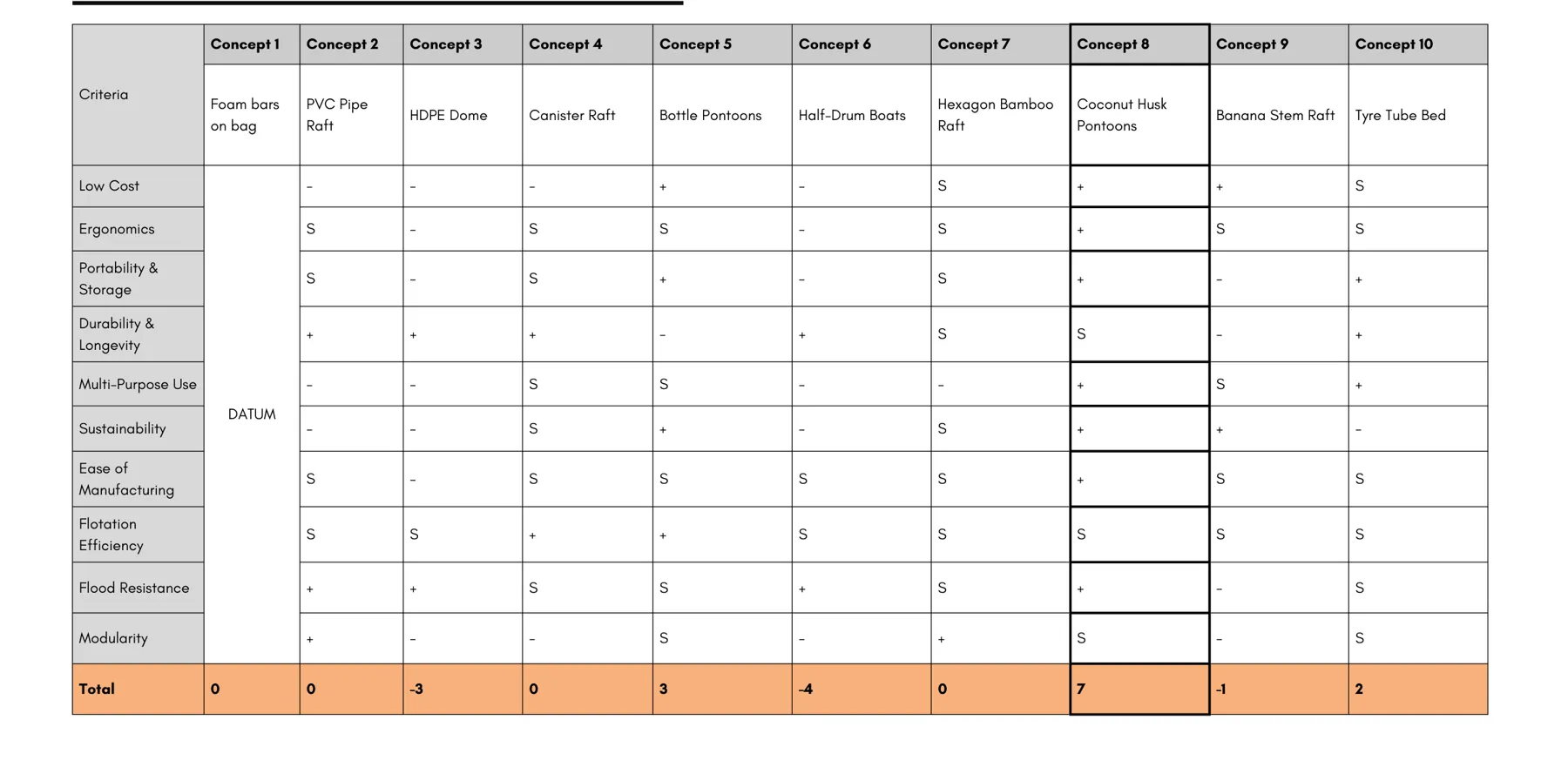
Twenty material concepts were compared in a Pugh chart. The winner: a bamboo platform on two rolled bundles of coconut husk netted with fishing net and tied with coir.

Ergonomics here meant more than handles: loads, stacking height, cost and what happens to the materials after the flood all had to fit how char farmers already live.
Char farmers are small landholders with little access to consistent government aid, but deep river knowledge: they already build stilt houses and move grain to community halls (namghars), schools and embankments when the water rises. Our job was to fit that culture, not replace it.
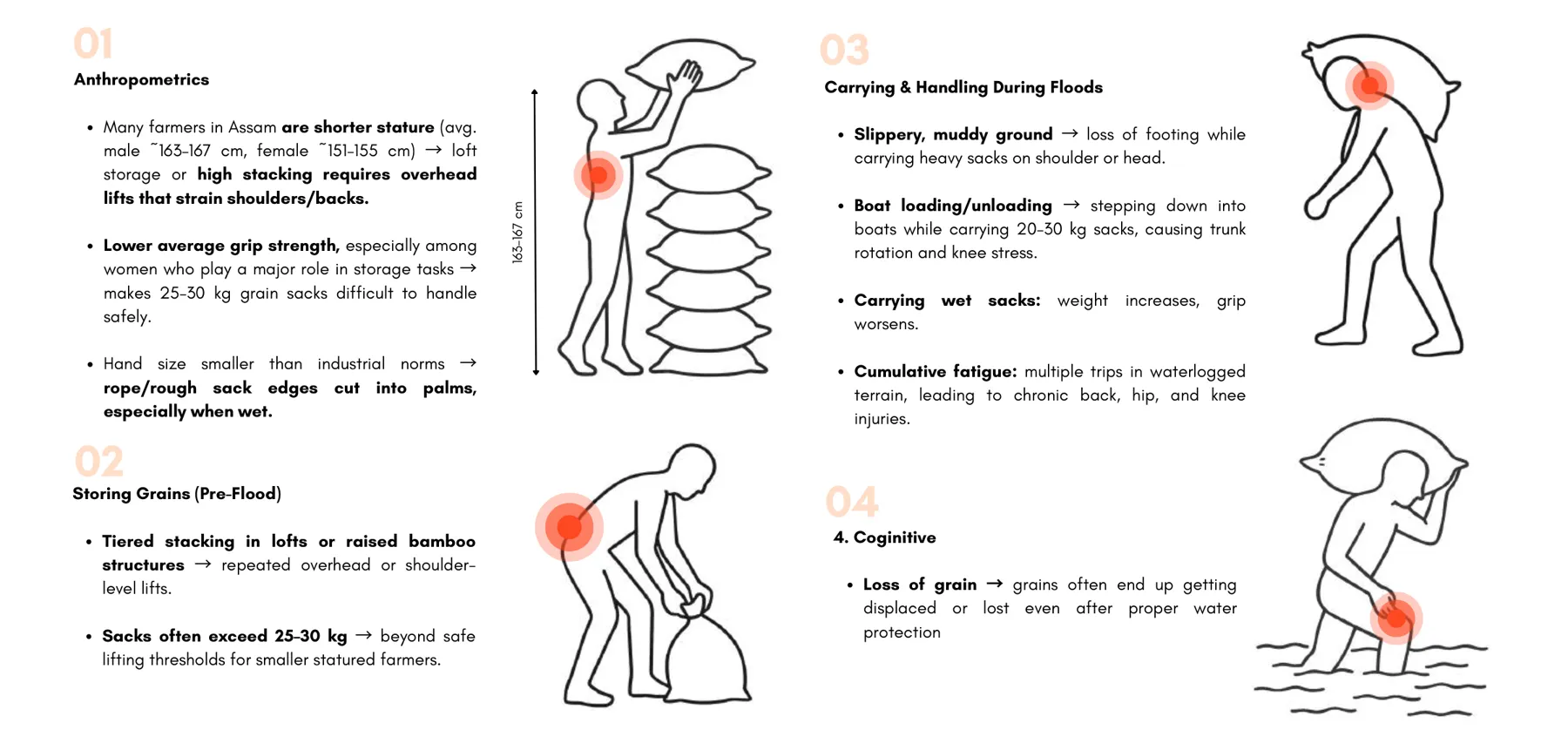
We mapped what storing and moving grain does to the body. Farmers in Assam are shorter on average (men ≈163–167 cm, women ≈151–155 cm), so loft storage means overhead lifts. Sacks often weigh 25–30 kg, beyond safe limits, and get heavier and slipperier when wet.
The research turned into four hard rules for any concept.
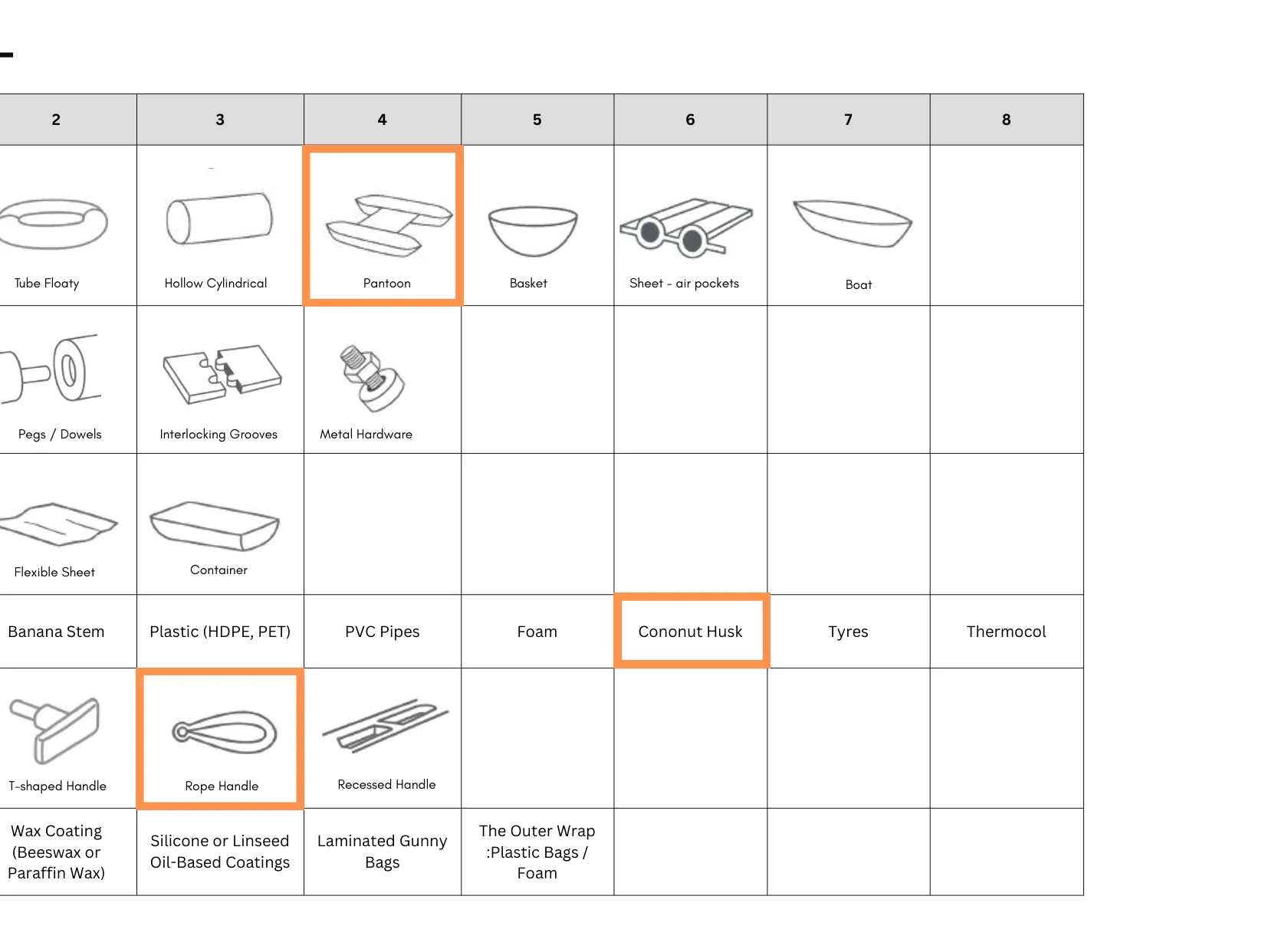
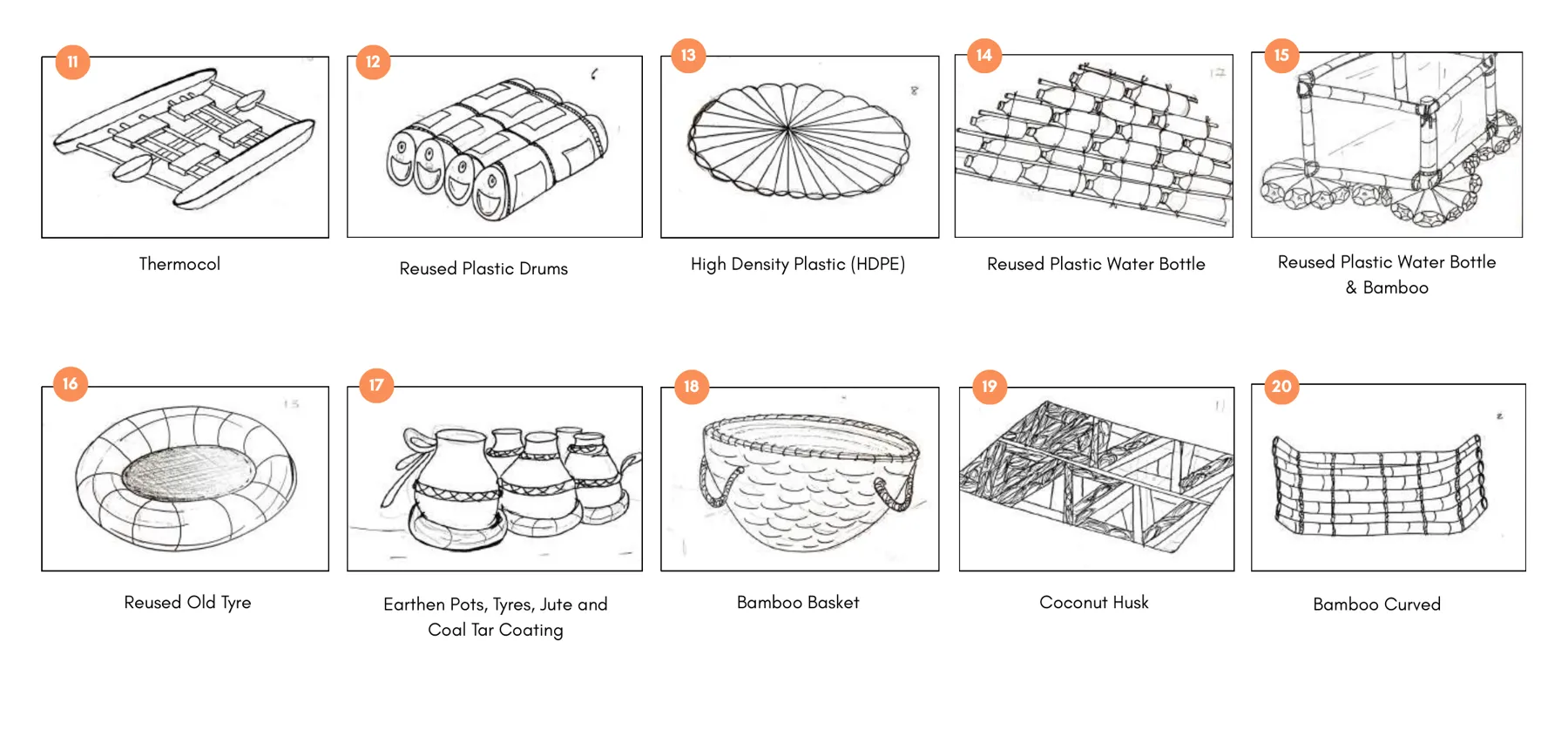
A morphology chart crossed buoyancy devices, materials (bamboo, banana stem, HDPE, PVC, coconut husk, tyres), water protection, connections and handles. That produced twenty concepts, from bottle pontoons and half-drum boats to banana-stem rafts.
A Pugh chart scored the concepts on cost, ergonomics, portability, durability, multi-use, sustainability, ease of making, flotation, flood resistance and modularity. Coconut husk with bamboo came out ahead: nearly free, buoyant, local and compostable.
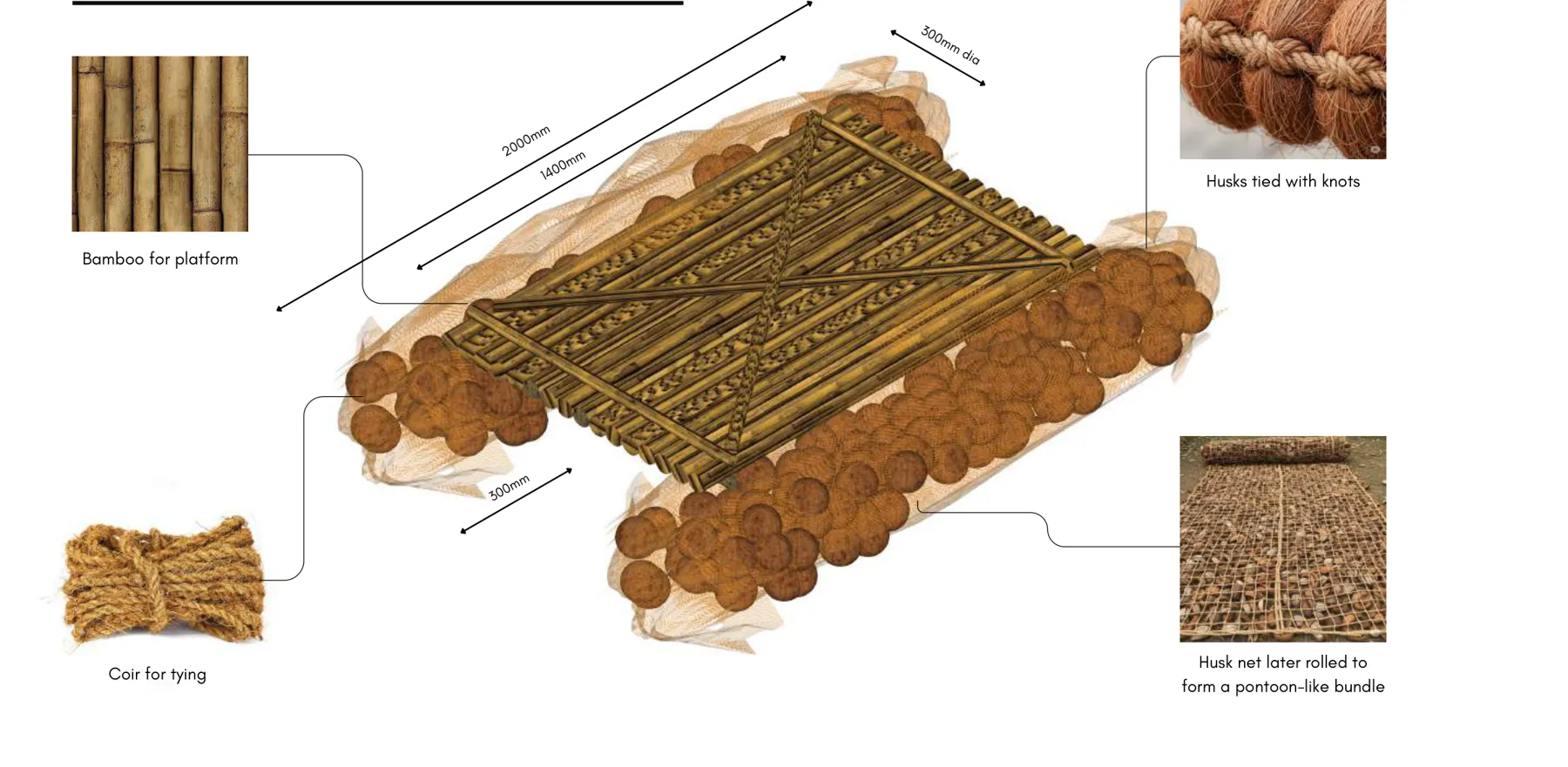
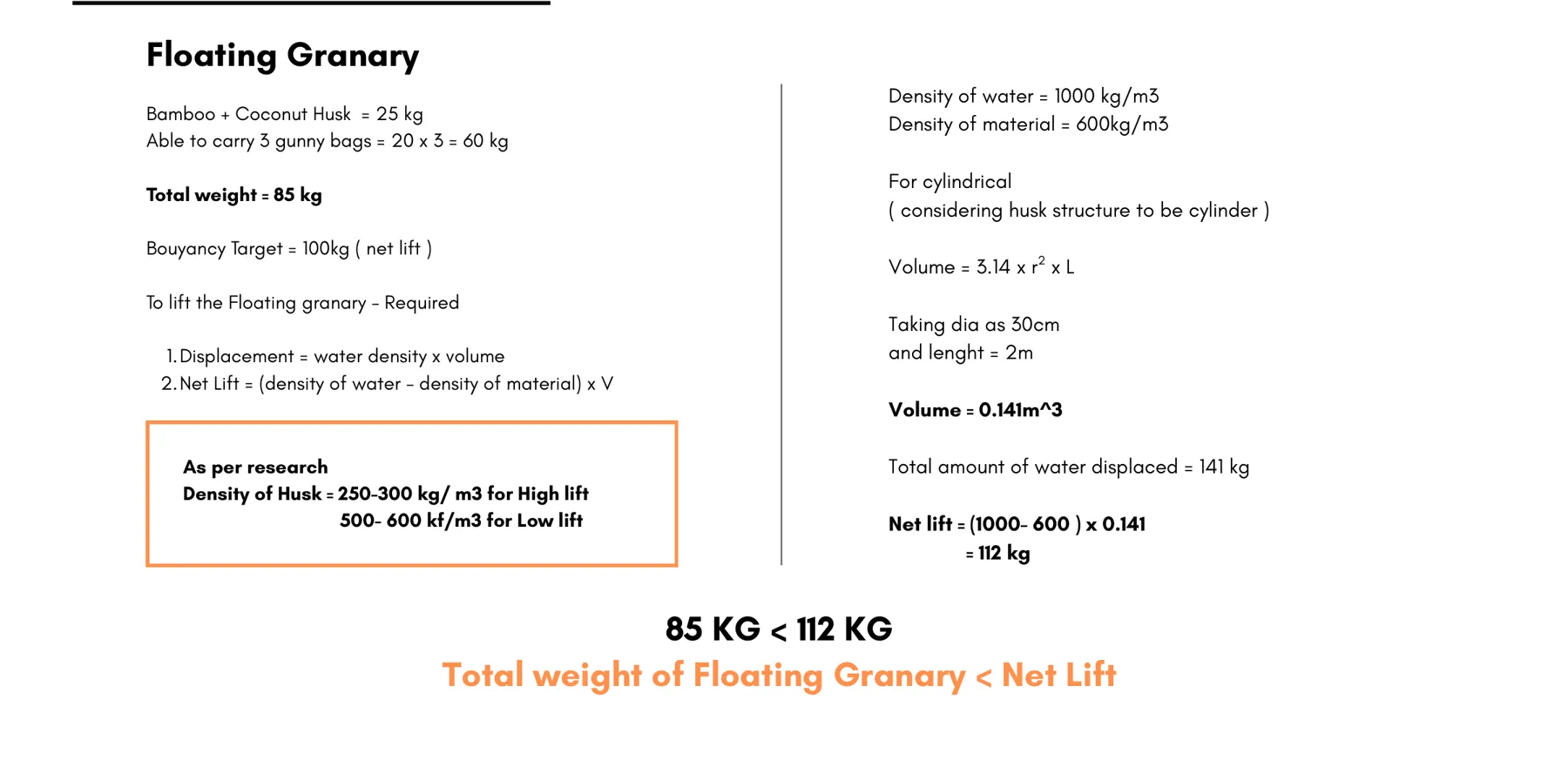
We checked buoyancy by hand: two husk rolls 30 cm across and 2 m long displace about 141 kg of water, for a net lift of about 112 kg. The loaded raft weighs 85 kg, so it floats with margin. Most materials are already on the farm, so cost runs from about ₹50 to ₹350.
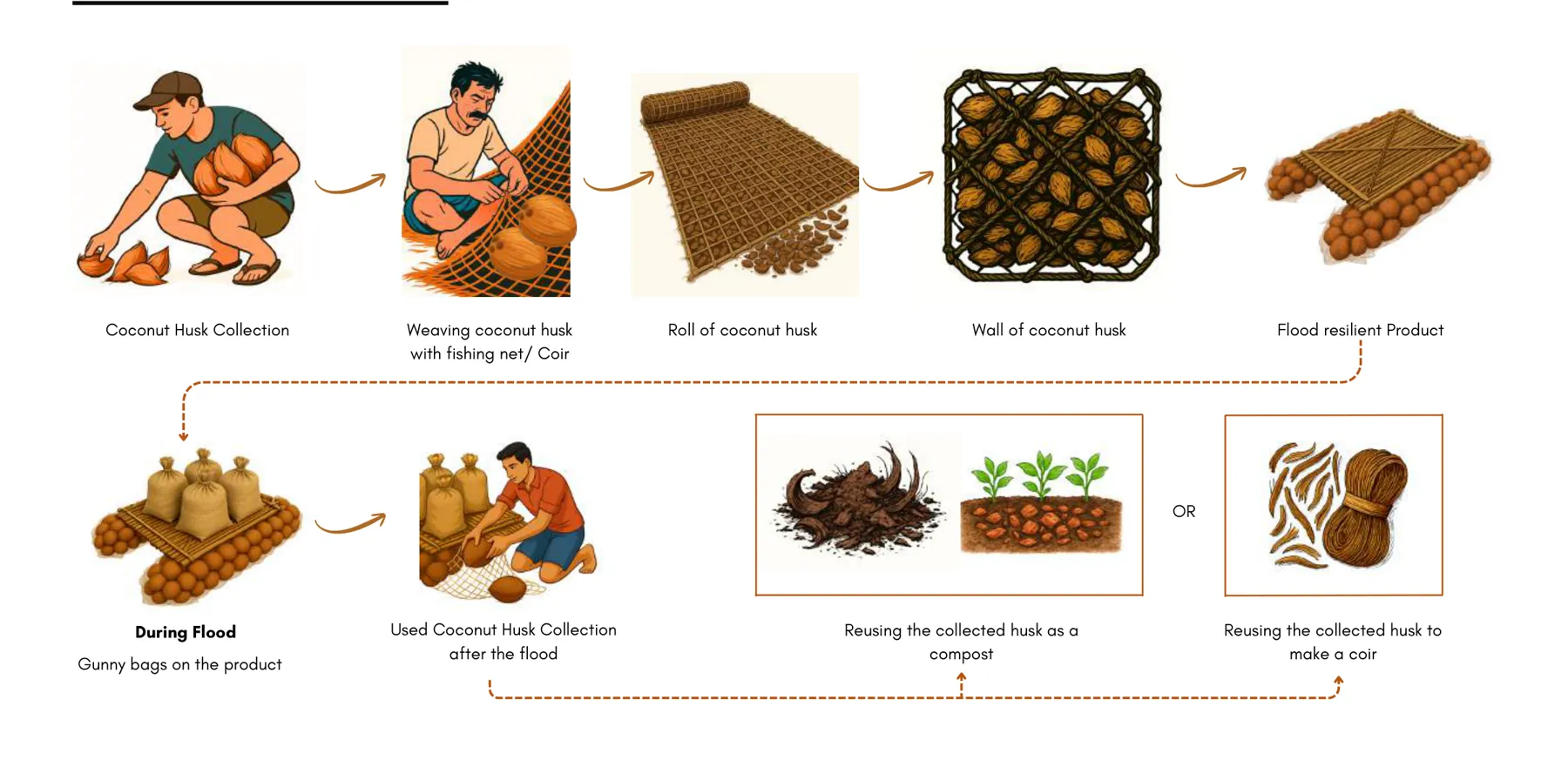
The husk isn’t waste at any stage. Before the monsoon it stands as a husk wall for farm shelter; during the flood it floats the grain; afterwards it becomes coir rope or compost for the next season.